
It started with an Alaska Airlines card, a generous gift, and a flight to Tokyo!
I have a confession: I’ve been collecting airline miles since my early 20s! Long before I understood transfer partners, welcome bonuses, or the finer points of a spreadsheet, I had an Alaska Airlines credit card. Living in the Pacific Northwest, Alaska has always been an obvious choice because of the flights available through Seattle.
Dan and I didn’t grow up jet-setting around the world. In fact, our first major overseas adventure was two months backpacking through Europe in our early 20s, and we were both still figuring out the whole travel thing. Not long afterward, I became fascinated with the miles that showed up in our accounts after flights and credit card sign-up bonuses.
Then the family I nannied for in Seattle gave me what felt like a once-in-a-lifetime birthday gift: Dan and I could choose round-trip flights booked with their Alaska miles. Rather than immediately picking an obvious domestic route on Alaska Airlines, like Hawaii, I did what I apparently have always done: I researched every possible option until I found the most interesting and valuable use of the resources available.
Most domestic flights were priced in the same general mileage range as an international partner trip to Japan. I remember feeling slightly ridiculous and unworthy emailing them a mini cost-benefit analysis to explain why flying all the way to Tokyo wasn’t actually a more extravagant use of their generous gift, but they agreed - and even spent extra miles to get us home nonstop instead of my bargain route through Chicago. Maybe they just wanted their nanny back at work sooner. I’ll never know!
That experience changed how I thought about miles. By thinking outside the box, I had a tool that could unlock things I might otherwise never consider and thus began my journey into the points & miles game. In our early marriage and while the kids were young, we used our limited points knowledge to book “free” economy trips to Peru, Mexico, Puerto Rico, Paris, Ireland, and more! But it wasn’t until 2019 when we learned by accident that sometimes you stumble upon some pretty phenomenal business-class deals, and suddenly the next level of the points & miles game was unlocked.
On the brink of Covid, in late 2019, we booked business-class reward flights from Vancouver to Sydney on a Qantas 747 for a rate that rivaled our usual economy international fares. Upstairs in that super-deluxe upper cabin, we slept for about 8-10 solid hours, woke up on Christmas morning in Australia, and for the first time actually felt human after crossing multiple time zones! We arrived rested and able to enjoy the trip from day one! This experience completely changed how I viewed this little points & miles side hobby.
Now, after years of doing this - and after taking the free 10xTravel course that opened my eyes to an entire world beyond Alaska miles - I’ve developed a system. And because I’m a Professional Organizer, the systems might honestly be my favorite part! And now, it’s time for me to share all that I have learned with you!




First, Why Am I So Obsessed With Travel?
I spend my working life helping people manage the belongings they’ve accumulated. I know how much space, money, time, and emotional energy our stuff can require. Losing a parent young and sorting through a lifetime of possessions also shaped my perspective. These days, I’m much more interested in collecting experiences than collecting things.
People used to ask why we took the kids abroad when they were so little. “They won’t even remember it!” And sure, Kendall definitely doesn’t remember spending her first birthday at Disneyland Paris. But I do. More importantly, I’ve always believed that an experience can shape a child even if they don’t remember the specifics years later. It shapes who they are that day, the next day, and the next.
That’s my why. Not because every vacation has to be extravagant, and certainly not because everyone needs to travel the way we do. I just want more people to realize the experiences they dream about might be more attainable than they think!
Points & Miles 101: The Five-Minute Version
This is not meant to replace the hundreds of excellent rewards guides already out there. Think of this as the starter explanation I’d give you over coffee before showing you how I keep it all organized.
Miles and points are rewards you earn through eligible purchases, flights, shopping portals, and - often most significantly - credit card welcome offers.
Not all points are the same. Alaska Atmos Rewards points stay in that loyalty program; Chase Ultimate Rewards, Capital One miles, and Amex Membership Rewards are separate bank currencies that can transfer to airline and hotel partners.
A transfer partner is an airline or hotel loyalty program that accepts points from an eligible bank rewards program. That lets you book travel through the partner rather than necessarily through your credit card’s travel portal.
Award availability matters. A flight may exist for cash but not be available for a reasonable number of miles - and a transfer usually cannot be undone.
Your goal is not always the highest mathematical value. It is using rewards for something useful to YOU, without paying interest or spending money you otherwise wouldn’t spend.
If that all sounds like another language, don’t panic. The free 10xTravel course is where I recommend starting. It covers the mechanics far more thoroughly than I could in one blog post. I took it years into my miles journey and still felt like someone had opened a whole new door!
The Golden Rule: Points Are Not Worth Credit Card Debt
Before I tell you how I earn points, let me be very clear: I do not carry credit card debt, and I don’t pay interest to earn rewards. If you cannot reliably pay your statement balances in full by the due date, I would not recommend getting into this hobby through credit card sign-up bonuses.
I used to pay my cards down to zero almost immediately, every Friday on my scheduled “bill pay” day as I call it. After learning how statement dates work, I now typically let the statement post and then pay the full statement balance by the due date. I also have full-statement autopay set up as a safety net. If a balance is unusually high, I’ll make an early payment before the statement closes to keep reported credit utilization reasonable. You never have to pay interest to build credit, and reporting a big balance can temporarily hurt your score.
Opening new cards can cause temporary credit-score dips, and approval isn’t guaranteed. My credit score has actually never been better, but that’s my experience - not a promise about yours. If you’re applying for a major loan soon, or the idea of managing another card feels stressful, that matters more than a flashy bonus.

Three Ways I Earn Points
1. Welcome Bonuses: The Biggest Accelerator
People often assume I earn most of my points by charging my Professional Organizing business expenses. Business spending does contribute, but the big accelerators have been welcome bonuses, smart spending categories, and shopping rewards.
A welcome bonus might offer a large batch of points after you spend a specified amount within a set period. My rule is to finish the current bonus spending requirement before moving on to the next application. Dan and I stagger cards, sometimes using eligible business cards too, rather than applying for everything at once.
I try to time those applications around expenses we already know are coming: a renovation, tuition, taxes, travel, or an unusually expensive month. I never want to manufacture purchases simply to hit a target.
Sometimes an expense such as property taxes or tuition can be paid with a card for a processing fee. Do the math first. If a $6,000 payment has a 2% fee, that’s $120 extra. If that payment helps you earn a hypothetical 100,000-point bonus that you later redeem at 1.5 cents per point, the redemption would be worth $1,500 - before subtracting the $120 fee, any card annual fee, and other costs. That value is an example, not a guaranteed cash return. If the same points would only give you $500 of value, the decision looks different.
A quick note for side hustlers: some sole proprietors can qualify for business credit cards without an LLC, including legitimate freelance or resale businesses. But a business card application must reflect real business activity and follow the issuer’s rules. I also keep business and personal spending appropriately separated.
I also keep Chase’s commonly discussed “5/24” guideline in mind when planning applications: Chase has historically been restrictive when applicants have opened five or more personal cards across issuers in the preceding 24 months. It’s an unofficial, changeable guideline - not a guarantee of approval or denial. And yes, Dan and I sometimes refer each other for cards when eligible, which may generate an extra bonus for the person sending the referral.
2. Category Bonuses: Let Your Normal Spending Do More Work
When I’m not working toward a welcome offer, I pick the card that suits the purchase. That’s it. We spend money on groceries, restaurants, family travel, and ordinary life anyway; I want that same spending to work a little harder.
My everyday card is the Capital One Venture X because it earns 2x miles on eligible everyday purchases. We use Amex Gold for eligible U.S. supermarket shopping at 4x, and the Atmos Summit is an important part of our Alaska/foreign-spending strategy. Our Chase Sapphire Preferred has also become useful for Airbnb and other eligible vacation rentals at 3x. Merchant coding and spending caps can affect these rates, so I always check the actual terms and how purchases post.
And when I’m trying to earn a new welcome bonus? That card may take priority over my usual category choices. There’s no point maximizing an extra 1x at the grocery store if I miss a much larger bonus deadline.
3. Rakuten: A Simple Habit That Adds Up
Here is one of my favorite tricks that does not involve opening another card: Rakuten. It’s a shopping website, browser extension, and app that offers rewards when you begin an eligible purchase through its link or activate an offer. (Note: If you sign up using my link, you will earn a bonus $50 cash back reward OR 5000 Amex Membership Reward points!)
Many people use Rakuten for cash back, but eligible Amex Membership Rewards cardholders can link their accounts and elect to receive Membership Rewards points instead of cash. For example, an eligible 20% cash-back offer can translate to 20 Amex points per dollar. Offers, eligible purchase amounts, and exclusions change all the time.
One of my favorite uses is booking family excursions through Viator when Rakuten has an elevated rate. Imagine a $1,000 tour for four people during an eligible 20x promotion: that could mean 20,000 Amex Membership Rewards points from Rakuten, potentially in addition to the rewards earned on the credit card itself. The full $1,000 would have to qualify, and rewards can be adjusted or reversed.
One Professional-Organizer caveat: a 20x offer is not permission to buy 20 new things you don’t need. The goal is to take an expense you were already making and earn a little extra - not bring home more clutter!
My habit is simple: before I check out online, I look for a Rakuten offer, read the exclusions, activate it, and complete the purchase. It takes seconds when you remember to do it!

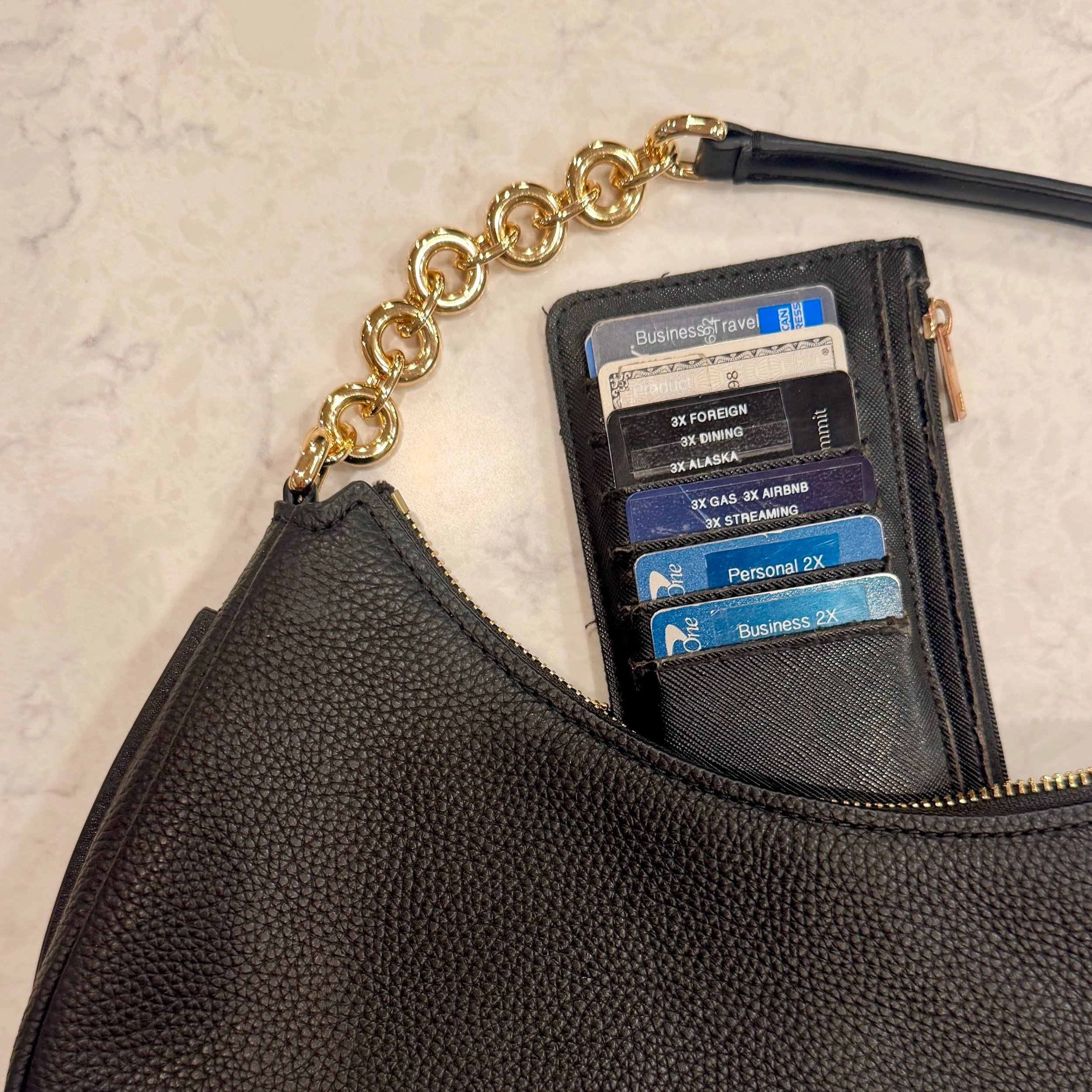


How I Organize 20+ Credit Cards Without Losing My Mind
This is the part where I get to put on my Professional Organizer hat! When I started opening more cards after the 10xTravel course, I realized quickly that this could become an expensive mess without a reliable system. I didn’t want to miss payments, lose track of welcome offers, or pay annual fees for benefits I forgot to use. So I taught myself Google Sheets! (Dan was the spreadsheet person before that. I was determined to figure it out myself.)
My System Has Three Parts
First, one master spreadsheet. For each card I track the card name, the person or business holding it, the date opened, annual fee, next review date, welcome bonus and spending deadline, earning currency, and benefits or credits worth using. A separate tab tracks bonus spending categories. I can see the whole picture rather than playing “which account did that expense land in?” every week.
Second, a Friday appointment with myself. I spend about 30–60 minutes reviewing every account balance, checking autopay, updating the spreadsheet, and looking at annual fees or credits coming up. I also read the Daily Drop newsletter with my coffee most mornings - maybe 10 minutes. That’s the basic maintenance. Award-flight hunting is another matter entirely. Give me a good puzzle and I can vanish down a rabbit hole for hours.
Third, labels. Yes, I literally put label tape on my credit cards. “GROCERIES 4X.” “EVERYDAY 2X.” “AIRBNB 3X.” It sounds absurdly simple, but when you’re standing at a register, you don’t want to pull up a spreadsheet to remember which card to use. I only keep the cards I’m actively using in my wallet; some older cards live securely in a file, and I review whether they’re worth keeping each year. A recurring legitimate charge may help keep one active, but doesn’t by itself guarantee any particular annual benefit.
You do not need to become an Excel wizard. Start with my basic sheet or an established template that works for you. Apps can also aggregate balances and benefits, but I prefer the hands-on approach because I’m cautious about connecting all of my financial logins to another service. Choose the system you will actually maintain.
What’s In My Wallet (and why)
Rewards categories and annual credits change, so I treat this as a snapshot, not a permanent ranking. These are the cards that make sense for how OUR household spends and travels. I’m not suggesting everyone needs all of them.
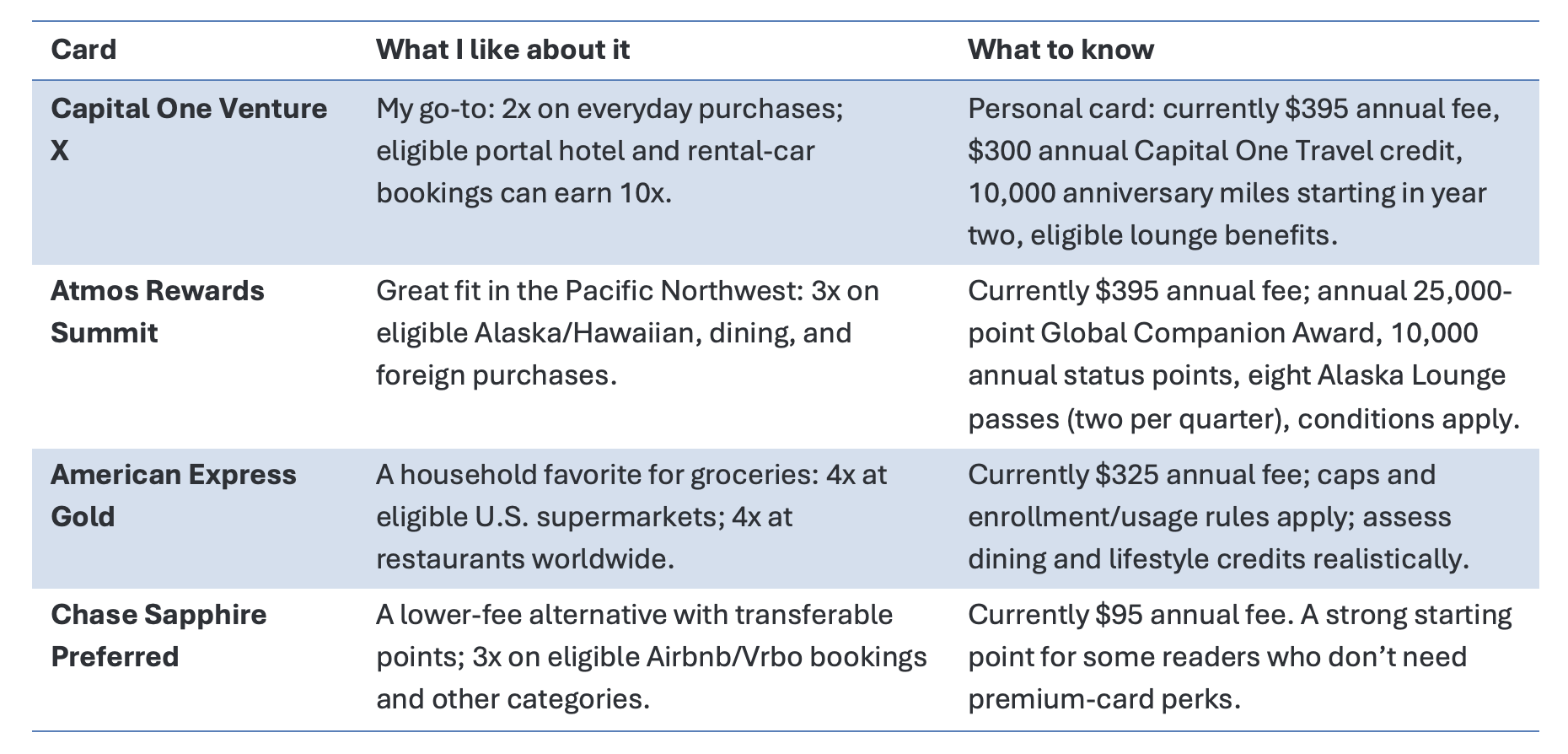
Annual fees current asa of November 2026.
Use these card referral links to browse the different card offers with each issuing bank. Sign up bonuses can vary, but using one of my links may result in bonus point earnings for both of us! Note: Alaska does not have a referral link.
Capital One
American Express
Chase
If you run a legitimate small business, the Chase Ink family is also worth researching; the right option depends on the type of business expense and the card’s terms. I don’t recommend opening a business card solely because someone on the internet says it’s a shortcut to bonus points.
My Quick Card-Label Cheat Sheet
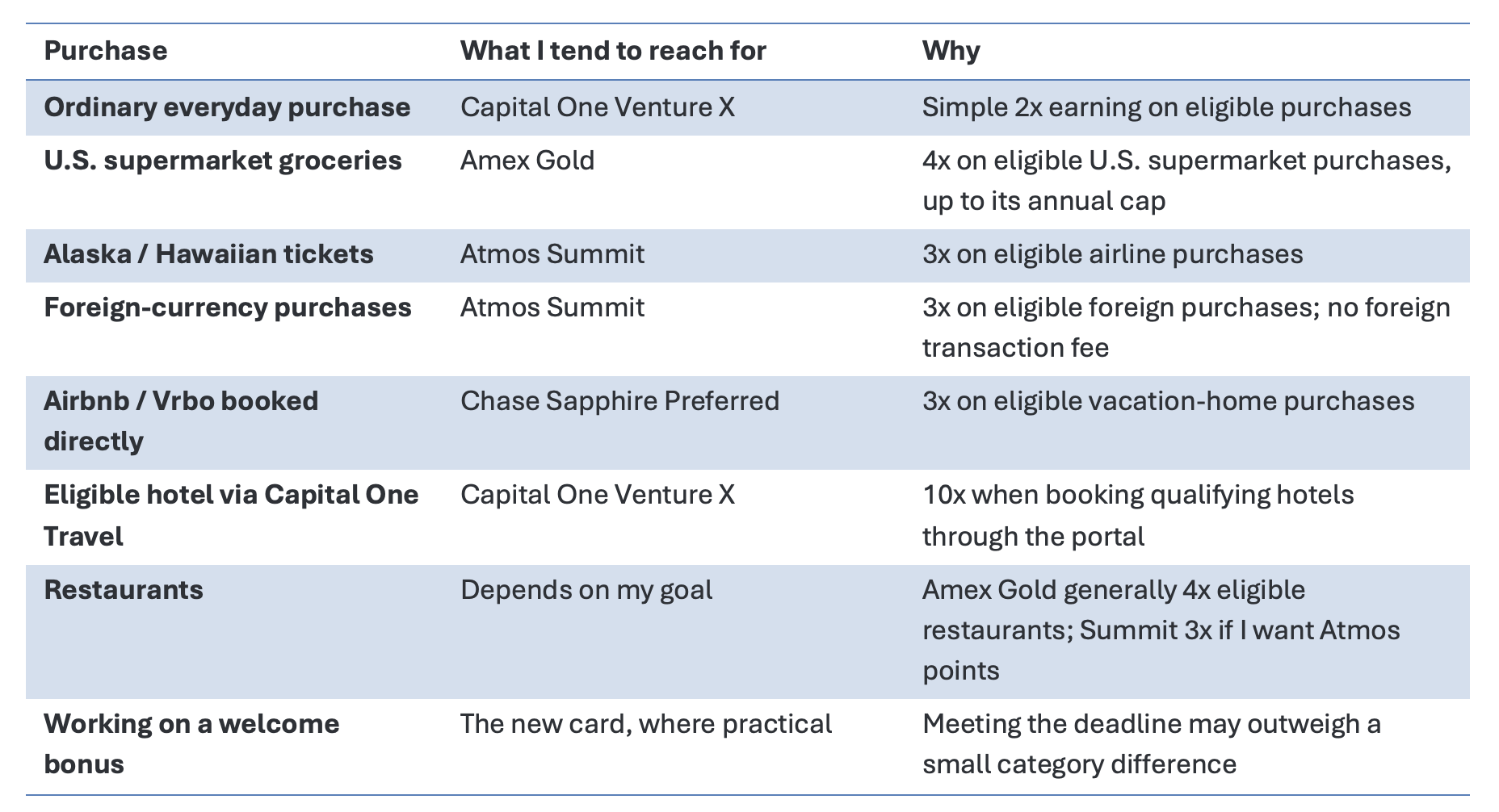
At the time of posting (November 2026) these bonus categories are accurate, but reconfirm as rates and categories change.
A note about premium annual fees: I think of them a little like subscriptions. I’m paying for a set of benefits, but I only count a credit at full value if I would have spent that money anyway. That might mean travel credits, lounge access, application-fee credits for Global Entry or TSA PreCheck, or relevant restaurant and shopping credits. My spreadsheet reminds me to use what I already have; it does not persuade me to spend money to “save” money.

How I Turn Those Points Into Trips
Sometimes it Happens Over Coffee: Take Tahiti for Example
Our Tahiti trip happened the way many of our trips happen. I knew the airline booking window had opened for summer travel. I was on the couch with coffee, working through a running Notes-app list of places we’d love to visit, checking departure dates and airports, and seeing what I could find with Alaska points.
I found business-class flights to Tahiti for approximately 50,000 points plus about $20 per person, one way. I booked them and texted Dan something along the lines of: “You’re going to need to request time off. We’re going to Tahiti.”
We often let the airfare deal determine the destination instead of choosing one place and insisting on specific dates. It’s one reason I keep a wish list of destinations we’d love to visit over the next five to ten years. When a compelling opportunity appears for somewhere on that list, I’m ready to take it!
Award calendars vary by airline, often opening roughly 11–12 months ahead, and award seats are not guaranteed just because the calendar opens. I like to look early for popular school-break dates, but I also check later when availability changes. Once the airfare is booked, I often leave the rest alone until I’m ready to plan the details.
CLICK HERE FOR MORE STRESS-FREE TRAVEL PLANNING TIPS!
My Beginner-Friendly Flight-Booking Process
I start by finding the actual award seat - not transferring a single point. Here’s the simplified version:
Pick a destination or a few options from your wish list, plus a flexible date range if possible.
Check award prices directly in an airline loyalty program, or use a search tool like point.me to compare multiple programs. I pay for point.me because it saves me time and helps me understand transfer options.
Check the total points AND taxes/fees, the operating airline, baggage terms, connection times, and cancellation rules. The same seat may be bookable through more than one loyalty program at different prices, but only if each program has access to that award space.
Confirm the award seat is still available. If you need transferable bank points, verify that your card can send points to the program and that the account names meet the bank’s rules. Then transfer only what you need; partner transfers are generally final.
Book directly with the airline or hotel loyalty program and save the confirmation in your trip-planning system.
A flight on a oneworld carrier such as British Airways, for example, might appear through British Airways’ own program and some partner programs, including Alaska or American, with different award pricing. The fact that the airlines are partners does not guarantee every seat will be available at every price through every program. That’s exactly the kind of puzzle I enjoy solving!
Can You Combine Points & Miles From Different Credit Cards? YES - Sometimes, But Read This First
This question came up repeatedly on Instagram, and the answer needs a tiny bit of nuance. You cannot simply dump every kind of reward into one magical universal points account. There are three different ideas people often call “combining”:
Same-bank combining: some banks let you move or combine rewards among eligible cards. Chase, for example, permits certain moves between your own Ultimate Rewards cards and with one eligible household member, subject to restrictions.
Different banks to one shared travel partner: sometimes two different bank programs both transfer to the same airline. For example, eligible Chase and Amex points can both transfer to Air France–KLM Flying Blue. You could move points from each program into your eligible Flying Blue account for a booking; you cannot move Chase points directly into Amex.
Family or airline-program pooling: some airline or hotel programs allow sharing or pooling under their own rules. Others charge fees or do not allow transfers. Amex does not let you simply transfer Membership Rewards points into a spouse’s separate Amex rewards account; eligible transfers to a linked authorized user’s travel loyalty account have special rules.
My preference is to keep flexible points in their original bank accounts until I have a particular redemption in mind. That preserves my options and avoids moving points into an airline program only to discover the flight is gone. Not every bank can transfer to every airline, so check BEFORE you move anything. The rule is: find the seat, confirm the route, check the partner, then transfer.
Hotels Can Be A Good Use of Points, Too
We often choose Airbnbs because having a kitchen works better for our family, so I tend to save our points for international flights. But I absolutely use hotel points when the opportunity makes sense!
For an upcoming New York trip, I had approximately 75,000 IHG points and needed 90,000 more for a four-night stay. During an IHG 100% purchase-bonus promotion, I bought 45,000 points for $450 and received another 45,000 bonus points. That gave me the additional 90,000 points I needed, bringing the total to about 165,000.
The hotel’s cash price was more than $2,000 for our dates. I did NOT get a $2,000 hotel for only $450; my existing 75,000 points had value too. But spending $450 to complete a redemption we genuinely wanted was a worthwhile choice for us. I never recommend buying points speculatively just because there’s a sale. Check the actual room or seat availability and the all-in cash comparison first.




A Few Questions I Hear All The Time…
Do I have to keep opening new credit cards?
No. You can earn rewards with one card for years. Welcome bonuses tend to accelerate earnings, but they’re not the only path. I don’t recommend churning through applications unless you enjoy managing the details, have a plan, and can meet every requirement without overspending.
What if I only travel once a year - or once every three to five years?
Then build a system appropriate to that! Maybe you spend less than an hour a week on it and redeem for one meaningful trip. Just check the expiration rules and the risk of program devaluations before stockpiling rewards for years. There is no universal points-expiration rule: some bank rewards do not expire while the relevant account is open and in good standing, and Alaska’s Atmos points do not expire under its program rules, but other programs and account closures can be different.
Can I book an Airbnb with points?
Sometimes. Certain travel rewards can be used to cover eligible vacation-rental charges, including Capital One miles against eligible travel purchases within the issuer’s time window. But using points to wipe out a charge is different from transferring points to an airline for a potentially high-value flight. For us, paying for Airbnb with my Chase Sapphire Preferred and earning 3x on eligible bookings often makes more sense. It depends on your travel style and the alternative redemption value.
I have a mountain of Amex points. How do I use them?
First, create a free frequent-flyer account with an airline that is a participating Amex transfer partner, if you don’t already have one. Then look for a real award flight you want. Compare the price through different eligible programs, verify availability, link the correct account, transfer points, and book. You can also use Amex points for other redemption types, but values differ. The 10xTravel course and point.me are useful places to learn this process before sending a large balance anywhere.
What if I don’t want to travel?
You can often use eligible bank rewards for statement credits, cash back, gift cards, and other options. Redemption values differ substantially: Capital One, for example, provides ways to cover eligible recent travel charges as well as cash-out options, which may yield a lower value. A dedicated cash-back card may be a more sensible fit if travel truly isn’t your goal. I personally save my points for travel, but rewards should serve your life - not the other way around.
What happens when a big annual fee comes due?
This is when a spreadsheet earns its keep! I look at what I actually used, whether I’d still choose that card today, and whether I can justify the fee. If I’m thinking of canceling or downgrading, I sometimes ask the card issuer through online chat whether there are retention offers. On my Amex Business Platinum, I was offered approximately 50,000 points for $6,000 of spending over three months. Offers aren’t promised, and you must review the terms before accepting. If you’re closing an account, ask first about downgrading, any bonus-clawback or timing rules, the effect on your available credit, and whether you’ll lose unused rewards.
Do my kids need credit cards to earn airline miles?
No! I opened airline loyalty accounts for the kids when they were little so eligible flights could earn rewards in their own names. My hope is that each will eventually have a little travel bank for a graduation adventure. Paid and award flights may earn different kinds of rewards or none at all, so check the airline’s rules when crediting a flight.
What about Bilt or Rove?
Both are worth knowing about if you enjoy learning about new ways to earn rewards. But I haven’t used them enough to give a personal recommendation, and their programs evolve. I’d rather point you toward current independent reviews and program terms than pretend to be an expert in something I’m not using.

How to Start Without Getting Overwhelmed
Here is exactly what I would tell a friend who has never done this before: learn the fundamentals, decide what kind of reward you’d actually use, and choose ONE appropriate card. Before you put even your first purchase on it, open your tracking spreadsheet. Record the annual fee, minimum spending target, deadline, payment due date, and any benefits you intend to use. Set full-statement autopay, and schedule a short weekly check-in.
I know it feels silly to make a spreadsheet for one credit card. I promise it’s less silly than trying to reconstruct the details of 12 cards after the fact.
If a premium card fee makes you uneasy, you do not need to start with my favorite card. A lower-fee option like Chase Sapphire Preferred - or even a straightforward no-annual-fee cash-back card - might better fit your spending and travel goals. The best starter card is the one you can manage confidently and use responsibly, not the one with the most impressive Instagram headline.
What I Hope You Take Away
I’m not asking you to become a person who manages 20+ credit cards or spends hours hunting for premium-cabin seats. I’m asking you to consider what the money you already spend might make possible with a little more intention - and to build a system that keeps it simple.
For me, points and miles are not really about the points and miles. They’re about the places we’ve seen, the people we’ve met, the mornings we’ve woken up somewhere new, and the chance to watch our kids experience the world. I know they won’t remember every detail. I don’t either. But I believe those experiences shape us anyway.
As a Professional Organizer, my job is to help people create space for what matters. This is one of the ways I’ve made space for more of what matters to our family.
You don’t have to start big. You just have to start organized!




Resources I Use
point.me award-flight search
Disclosure: Some card and shopping links in this article may be referral links. If you apply or sign up through one, I may receive points or another reward, at no additional cost to you. I share cards I use or genuinely believe may fit a reader’s needs; receiving a referral bonus does not determine whether I recommend a card. Rates, annual fees, rewards, offers, transfer partners, and eligibility can change. Please confirm current terms with the issuer before applying. This is my personal experience, not individualized financial, legal, or tax advice.
